





Human Rights Defense Center v. Schnell, MN, Order, Censorship, 2026
Download original document:
Document text
Document text
This text is machine-read, and may contain errors. Check the original document to verify accuracy.
CASE 0:26-cv-00073-JRT-ECW

Doc. 45

Filed 08/14/26

Page 1 of 25

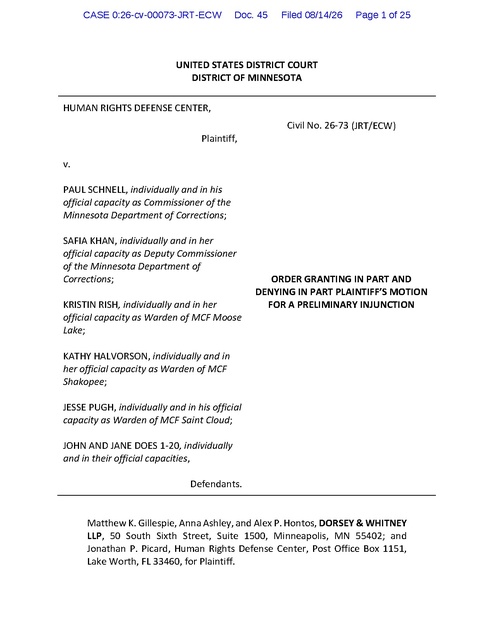
UNITED STATES DISTRICT COURT
DISTRICT OF MINNESOTA
HUMAN RIGHTS DEFENSE CENTER,
Plaintiff,

Civil No. 26-73 (JRT/ECW)

v.
PAUL SCHNELL, individually and in his
official capacity as Commissioner of the
Minnesota Department of Corrections;
SAFIA KHAN, individually and in her
official capacity as Deputy Commissioner
of the Minnesota Department of
Corrections;
KRISTIN RISH, individually and in her
official capacity as Warden of MCF Moose
Lake;

ORDER GRANTING IN PART AND
DENYING IN PART PLAINTIFF’S MOTION
FOR A PRELIMINARY INJUNCTION

KATHY HALVORSON, individually and in
her official capacity as Warden of MCF
Shakopee;
JESSE PUGH, individually and in his official
capacity as Warden of MCF Saint Cloud;
JOHN AND JANE DOES 1-20, individually
and in their official capacities,
Defendants.
Matthew K. Gillespie, Anna Ashley, and Alex P. Hontos, DORSEY & WHITNEY
LLP, 50 South Sixth Street, Suite 1500, Minneapolis, MN 55402; and
Jonathan P. Picard, Human Rights Defense Center, Post Office Box 1151,
Lake Worth, FL 33460, for Plaintiff.

CASE 0:26-cv-00073-JRT-ECW

Doc. 45

Filed 08/14/26

Page 2 of 25

Edwin W. Stockmeyer, III, and Bradley Simon, MINNESOTA ATTORNEY
GENERAL’S OFFICE, 445 Minnesota Street, Suite 600, St. Paul, MN 55101,
for named Defendants.
Plaintiff Human Rights Defense Center (“HRDC”) brought an action against several
Minnesota Department of Corrections (“DOC”) officials (collectively, Defendants),
alleging that the DOC’s rules about who can send books to incarcerated people violate
the First and Fourteenth Amendment rights of HRDC and of people in the custody of the
DOC.

HRDC now moves for a preliminary injunction enjoining Defendants from

disapproving publications published or distributed by HRDC on the ground that HRDC is
not an “approved” vendor under the DOC’s current policies. HRDC further asks the Court
to require Defendants to advise HRDC of the grounds for any disapproval, rejection, or
refusal to deliver publications published or distributed by HRDC and to require
Defendants to advise all DOC employees of the terms of the preliminary injunction. In
their motion papers, HRDC only requested relief on its own behalf, but during oral
argument, HRDC made it clear that it was challenging the policies not just as applied to
HRDC but more broadly.
The Court will grant in part HRDC’s motion. Because the Court concludes that the
DOC’s policy as currently implemented is not necessarily content neutral, the Court will
order Defendants to issue a modified vendor application form and to develop and share
guidelines indicating how vendors are reviewed.

If HRDC wishes to distribute its

publications to people incarcerated by the DOC, it will need to submit a complete
-2-

CASE 0:26-cv-00073-JRT-ECW

Doc. 45

Filed 08/14/26

Page 3 of 25

modified vendor application form, consistent with DOC’s modified process. If the DOC
denies HRDC’s application (or any other vendor’s application), Defendants will be
required to advise HRDC (or the relevant vendor) of the grounds for any such disapproval.
BACKGROUND
I.

FACTS
HRDC is a non-profit charitable organization. (First Decl. of Paul Wright (“First

Wright Decl.”) ¶ 2, Apr. 21, 2026, Docket No. 23.) 1 HRDC seeks “to educate prisoners and
the public about the destructive nature of racism, sexism, and the economic and social
costs of prisons to society.” (Id.) “HRDC accomplishes its mission through advocacy,
litigation, and publication and/or distribution of books, magazines, and other information
concerning prisons and the rights of prisoners.” (Id. ¶ 3.)
HRDC publishes and/or distributes several different books on criminal justice,
health, and legal issues including:
•

Prisoners’ Guerilla Handbook: A Guide to Correspondence Programs in the United
States and Canada (“Prisoners’ Handbook”), which provides information on
enrolling at accredited higher education, vocational, and training schools.

•

Prison Education Guide, which provides a comprehensive listing of correspondence
programs available to prisoners including a detailed analysis of the quality and cost
of each program.

1 Paul Wright is the Executive Director of HRDC. (First Wright Decl. ¶ 2.)

-3-

CASE 0:26-cv-00073-JRT-ECW

•

Doc. 45

Filed 08/14/26

Page 4 of 25

The Habeas Citebook: Ineffective Assistance of Counsel (“Habeas Citebook”), which
provides guidance for incarcerated persons seeking habeas relief.

•

Protecting Your Health and Safety (“PYHS”), which describes the rights, protections,
and legal remedies available to persons concerning their health and safety while
they are incarcerated.

(Id. ¶ 8.)
A.

Mail Policy

In October 2024, the DOC revised its procedures related to book vendors. (Id. ¶ 16;
Decl. of Ashlee Berts (“Berts Decl.”) ¶ 18, May 12, 2026, Docket No. 32.) The DOC changed
its policy so that incarcerated individuals could obtain books only from vendors on an
“approved vendor list.” (First Wright Decl. ¶ 16; Berts Decl. ¶ 18.)
The DOC’s revised policy stated:
Books must be purchased from approved vendors and
shipped directly from the publisher directly to the facility.
Books should be sent to the facility address . . . . As of October
21, 2024, only Hamilton Books, Harper Collins, and Penguin
Random House are approved.
Books ordered from
unapproved vendors will be returned or disposed of according
to DOC policy.
(First Wright Decl. ¶ 16, Ex. A. (providing information “as it appeared on [the DOC’s] public
website on November 5, 2024”); see also Decl. of Crystal Brakke (“Brakke Decl.”) ¶ 10, Ex.
D, May 12, 2026, Docket No. 35 (providing a copy of a memo issued to all DOC Facility
Staff dated October 11, 2026, which sets forth the list of approved books vendors and
states that “[b]ooks must be purchased from one of the three approved vendors . . . .”)).
-4-

CASE 0:26-cv-00073-JRT-ECW

Doc. 45

Filed 08/14/26

Page 5 of 25

According to the DOC, these three vendors “had been vetted and confirmed by the DOC
to be legitimate, and the DOC could verify [that they] would not send books that had been
altered to hide drugs.” (Berts Decl. ¶ 18.)
On November 8, 2024, HRDC sent a letter to the DOC requesting that the DOC
rescind the new policy because it violated HRDC’s First and Fourteenth Amendment
Rights. (First Wright Decl. ¶ 17, Ex. B.) The DOC did not respond to HRDC’s letter. (Id.
¶ 18.) The DOC claims that this letter was HRDC’s “sole alleged attempt to communicate
with DOC about DOC’s mailing rules.” (Mem. in Opp’n at 13, May, 12, 2026, Docket No.
30.)
On November 25, 2024, the DOC released a memo indicating it had “expand[ed]
its list of approved book vendors for incarcerated individuals” to also include Macmillan,
Simon & Schuster, and Hachette Book Group. (Brakke Decl. ¶ 11, Ex. E.)
In March 2025, the DOC again updated its approved book vendor list, removing
Macmillan and adding five non-profit organizations. (See id. ¶ 22, Ex. G.) Defendants
represent that “Mac[m]illan was eliminated from the prior list of approved vendors
because DOC discovered that it used third-party fulfillment services, rather than direct
order fulfillment.” (Id. ¶ 21.) The DOC posted these updates and additional rules in a
memorandum sent on March 20, 2025. (Id. ¶ 22, Ex. G (“Book Vendor Updates Memo”).)
The Book Vendor Updates Memo further provided that “[a]ny additional nonprofits

-5-

CASE 0:26-cv-00073-JRT-ECW

Doc. 45

Filed 08/14/26

Page 6 of 25

wishing to donate books to incarcerated individuals will be reviewed by the Deputy
Assistant Commissioner of Teaching and Learning.” (Id.)
That same day, the DOC posted a new policy governing publications sent to its
facilities. (See First Wright Decl. ¶ 19, Ex. C (“Publication Policy”). The current version of
the policy (“2026 Publication Policy”) is available online. 2 Both the Publication Policy and
the 2026 Publication Policy state:
Books are allowed from approved vendors and nonprofit
organizations and must be shipped directly from them to the
facility. Books ordered from unapproved vendors or nonprofit
organizations will be returned or disposed of according to
DOC policy. Books should be sent to the facility address . . . .
(Publication Policy at 1–2; see also 2026 Publication Policy.) The Publication Policy further
listed the approved publishers and nonprofit organizations. (Publication Policy at 2.)
HRDC alleges that the DOC’s policies “provided no mechanism for publishers like
HRDC to obtain ‘approved vendor status.’” (Mem. in Supp. at 13, Apr. 21, 2026, Docket
No. 22.) Instead, HRDC noted that the Book Vendor Updates Memo provided that any
other “nonprofits wishing to donate books to incarcerated individuals will be reviewed by
the Deputy Assistant Commissioner of Teaching and Learning.” (Id. (quoting Book Vendor
Updates Memo).)
Defendants explain that after posting the Book Vendor Updates Memo, they
received several requests from outside vendors seeking to be added to the approved list

2 https://perma.cc/78JE-6WF2

-6-

CASE 0:26-cv-00073-JRT-ECW

Doc. 45

Filed 08/14/26

Page 7 of 25

and so “began developing a process to consider those requests.” (Berts Decl. ¶ 20.)
“Eventually, the DOC developed a short application form that interested book vendors
could fill out and submit to the DOC to become approved vendors.” (Id.) That form
(“Vendor Application Form”) was then posted on the DOC’s website. (See id.; see also
https://perma.cc/VKN4-S4HP.) According to HRDC, the Vendor Application Form was not
posted until February 2026. (First Wright Decl. ¶ 22, Ex. F.) 3
The Vendor Application Form requires the applying organization to indicate if it
“provide[s] books or other material to other correctional facilities” and if so, to list those
facilities. (Id.) It also requires an applying organization to indicate if the “organization
[has] ever been denied permission to mail books or other material to a correctional
facility, had permission revoked, or otherwise been removed from a correctional facility’s
list of authorized vendors” and to “provide full details, including contact information for
those facilities.” (Id.) The form further states that “[r]equests will be reviewed on a
quarterly basis by Minnesota Department of Corrections staff.” (Id.) The policy does not
provide a way for incarcerated individuals to obtain books from non-approved vendors
nor does it appear that there is a way for incarcerated individuals to suggest that a vendor
be added to the approved vendor list.

3 A copy of the Vendor Application Form is attached as Exhibit F to the First Wright

Declaration.

-7-

CASE 0:26-cv-00073-JRT-ECW

Doc. 45

Filed 08/14/26

Page 8 of 25

HRDC has not submitted an application form to become an approved vendor. (See,
e.g., Berts Decl. ¶ 24.)
The DOC reports that the changes it “has made to its mail policies and book vendor
procedures have drastically reduced the amount of drugs that are being smuggled into
DOC facilities” and have resulted in a “significant reduction in drug-related incidents
including staff assaults and overdoses . . . .” (Id. ¶ 25.)
B.

HRDC’s Mail to DOC Prisoners

Between May 2025 and November 2025—after the DOC published its Book Vendor
Updates Memo and Publication Policy on March 20, 2025—HRDC sent books and other
materials (i.e., magazines, informational brochures, and correspondence) to individuals
confined at DOC facilities. (First Wright Decl. ¶ 21.) HRDC reports that 53 of those items
were returned to it by the DOC even though those individuals were still in the custody of
the DOC, including copies of PYHS, copies of the Prisoners’ Handbook, copies of the
Habeas Citebook, and copies of the Prison Education Guide. (Id. ¶¶ 21, 23.) Some but not
all of the items that were returned were marked “Unauthorized Vendor.” (Id. ¶ 24.)
HRDC claims that at least 59 additional books were delivered but were not returned. (Id.
¶ 25.) HRDC alleges that “Defendants failed to provide HRDC with notice that the items
mailed by HRDC to prisoners at MNDOC facilities were being censored and returned at

-8-

CASE 0:26-cv-00073-JRT-ECW

Doc. 45

Filed 08/14/26

Page 9 of 25

HRDC’s expense.” (Id.) 4 HRDC further alleges that Defendants “failed to provide HRDC
with an opportunity to appeal these censorship decisions before the items were rejected
and returned to HRDC.” (Id. ¶ 26.)
C.

Additional Access to Books at DOC Facilities

The DOC noted that its incarcerated population has access to books through
several other means, in addition to the mail.
First, the DOC highlights its library system. Each DOC facility has its own library
and the majority of the staff hold degrees in library science. (Decl. of Andrea Smith
(“Smith Decl.”) ¶ 4, May 12, 2026, Docket No. 36.) 5 The DOC maintains “a collection of
legal materials, referred to as the Core Collection, in each adult institution with the
exceptions of the boot camp facilities[.]” (Id. ¶ 7.) The Core Collection is the same at each
DOC facility . . . and includes . . . [HRDC’s publication] Protecting Your Health and Safety[.]”
(Id.) “Resources from the Core Collection cannot be checked out, but incarcerated
individuals can receive photocopies of them in compliance with policy and copyright law.”
(Id.) Material that is not available at a given DOC facility’s library can often be obtained
through interlibrary loan. (Id. ¶ 8.) Some facilities accept donated materials, but it is

4 The First Wright Declaration includes two paragraphs that are both designated as

paragraph 25.

5 Andrea Smith works for the DOC as the Senior Librarian at the Minnesota Correctional

Facility at Shakopee and has worked for the DOC since 2005. (Smith Decl. ¶ 1.)

-9-

CASE 0:26-cv-00073-JRT-ECW

Doc. 45

Filed 08/14/26

Page 10 of 25

space dependent. (See id. ¶ 11 (noting that the Shakopee facility is not currently
accepting donations but the St. Cloud facility regularly accepts donations).)
The DOC also highlights the Law Library Service for Prisoners (LLSP). (See id. ¶ 10.)
“Through LLSP, three librarians at the [Minnesota] State Law Library are available to
answer legal research questions they receive from incarcerated people through kites,
phone calls, or virtual chats. Their assistance includes providing incarcerated people with
photocopies of some legal materials available at the State Law Library.” (Id.) “LLSP limits
responses to 80 pages, or 8 items, per 2-week period.” (Decl. of Ed Stockmeyer ¶ 5, Ex. B
(Annual Report prepared by the Minnesota State Law Library concerning LLSP), May 12,
2026, Docket No. 37.)
II.

PROCEDURAL HISTORY
On January 7, 2026, HRDC filed its complaint. (Docket No. 3.) On April 21, 2026,

HRDC moved for a preliminary injunction. (Docket No. 21.) On April 24, 2026, the Court
set a briefing schedule: Responses due by May 12, 2026; Replies due by May 21, 2026.
The parties timely filed their briefs. A hearing was held on June 5, 2026.
DISCUSSION
I.

STANDARD OF REVIEW
The purpose of preliminary injunctive relief is to maintain the status quo. Tumey

v. Mycroft AI, Inc., 27 F.4th 657, 664 (8th Cir. 2022). The Court considers four factors for
a preliminary injunction motion: (1) the movant’s likelihood of success on the merits;
(2) the threat of irreparable harm to the movant in the absence of relief; (3) the balance
-10-

CASE 0:26-cv-00073-JRT-ECW

Doc. 45

Filed 08/14/26

Page 11 of 25

between that harm and the harm injunctive relief would cause to the other litigants; and
(4) the public interest. Dataphase Sys., Inc. v. C L Sys., Inc., 640 F.2d 109, 114 (8th Cir.
1981).
No one factor is determinative, and the court should “weigh the case’s particular
circumstances to determine whether the balance of equities so favors the movant that
justice requires the court to intervene.” Hubbard Feeds, Inc. v. Animal Feed Supplement,
Inc., 182 F.3d 598, 601 (8th Cir. 1999) (quotation omitted). “However, in deciding whether
to grant a preliminary injunction, likelihood of success on the merits is most significant.”
Turtle Island Foods, SPC v. Thompson, 992 F.3d 694, 699 (8th Cir. 2021) (cleaned up).
“Generally, if a party shows a ‘likely violation of his or her First Amendment rights, the
other requirements for obtaining a preliminary injunction are . . . deemed to have been
satisfied.’” Rodgers v. Bryant, 942 F.3d 451, 456 (8th Cir. 2019) (quoting Minn. Citizens
Concerned for Life, Inc. v. Swanson, 692 F.3d 864, 870 (8th Cir. 2012) (en banc)). The
moving party bears the burden to establish that these factors weigh in favor of granting
temporary relief. Watkins Inc. v. Lewis, 346 F.3d 841, 844 (8th Cir. 2003).
“[I]n the prison context, a request for injunctive relief must always be viewed with
great caution because judicial restraint is especially called for in dealing with the complex
and intractable problems of prison administration.” Goff v. Harper, 60 F.3d 518, 520 (8th
Cir. 1995) (internal quotation marks omitted).

-11-

CASE 0:26-cv-00073-JRT-ECW

II.

Doc. 45

Filed 08/14/26

Page 12 of 25

ANALYSIS
For HRDC to show it is likely to succeed on its claims, it must establish that the

DOC’s rules about who can send books to incarcerated people likely violate its First or
Fourteenth Amendment rights. The Court will first address the likelihood of success on
each of these claims before turning to the remaining Dataphase factors.
A.

Likelihood of Success on the Merits – First Amendment

HRDC argues that the DOC’s policies violate its First Amendment rights to
communicate with prisoners. “To determine whether a jail policy violates the First
Amendment rights of an entity seeking to communicate with inmates,” a court must
examine “whether the challenged policy is reasonably related to legitimate penological
interests.” Human Rts. Def. Ctr. v. Baxter Cnty., Ark. (Baxter II), 129 F.4th 498, 503 (8th
Cir. 2025) (internal quotation marks omitted).

The analysis is guided by four

considerations, often referred to as the Turner factors. Id.; see also Turner v. Safley, 482
U.S. 78 (1987).
(1) whether the policy has a valid rational connection to a
legitimate governmental interest;
(2) whether alternative means are open to those desiring to
communicate with inmates to exercise the asserted right;
(3) what impact an accommodation of the right would have
on guards and inmates and prison resources; and
(4) whether there are ready alternatives to the policy.
Baxter II, 129 F.4th at 504. The burden of persuasion is not on the Defendants to prove
the validity of its policy, but on the party challenging the policy (in this case, HRDC) to
-12-

CASE 0:26-cv-00073-JRT-ECW

Doc. 45

Filed 08/14/26

Page 13 of 25

disprove the validity of its policy. Hum. Rts. Def. Ctr. v. Baxter Cnty., Ark. (Baxter I), 999
F.3d 1160, 1164 (8th Cir. 2021).
1.

Turner Factor One: Valid Rational Connection

For the first Turner factor, the Court must examine whether there is a rational
connection between the DOC’s policy and a legitimate government interest. Turner, 482
U.S. at 89. Under this factor, “the governmental objective must be a legitimate and
neutral one.” Id. at 90. The DOC identifies the government interest as preventing inmates
and prison staff from being exposed to drugs.
The DOC’s policy of not allowing books from non-approved vendors is clearly
connected to the government interest identified by the DOC. But the way that the DOC
implemented its policy of approving vendors was not rationally related to its articulated
legitimate penological objectives, and Defendants have not yet provided guidelines that
will ensure the DOC will enforce the policies consistently prospectively.
As an initial matter, the Court concludes that the 2024 implementation of the
DOC’s mail policy was not content neutral. When first implementing the policy, the DOC,
without any application process at all, approved general interest publishers but not
HRDC—which specializes in speech regarding the rights of incarcerated individuals.
Moreover, although the DOC has indicated that its intent was to select publishers that do
not use third-party order fulfillment services (Brakke Decl. ¶ 12), the DOC did not approve
HRDC, which does use direct party fulfillment (Second Decl. of Paul Wright (“Second
Wright Decl.”) ¶ 2, May 21, 2026, Docket No. 41). Moreover, the DOC initially approved
-13-

CASE 0:26-cv-00073-JRT-ECW

Doc. 45

Filed 08/14/26

Page 14 of 25

Macmillan, a general publisher, only to later discover that Macmillan used third-party
fulfillment services, rather than direct order fulfillment. (See Brakke Decl. ¶¶ 21–22.)
Although the DOC has now updated its mail policy and indicates that it will review
a “book vendor or nonprofit organization” who submits its Vendor Application Form, the
DOC has not published—and Defendants have not disclosed—any guidelines that are
used when reviewing applicants. While there is nothing to suggest that the reviewers are
using the current policy to draw distinctions between publications based on content,
there are also no guidelines in place to prevent the reviewers from drawing distinctions
between publications based on content. 6 The Court concludes that HRDC has met its
burden of showing that the DOC’s mail policy, even as currently implemented, is not
content neutral, and therefore not rationally related to legitimate governmental interest.
2.

Turner Factor Two: Alternative Means

With respect to the second Turner factor, the parties disagree on whether HRDC
has viable alternative means to communicate with DOC inmates. The DOC emphasizes
that (1) HRDC can complete the Vendor Application Form or (2) inmates can access
HRDC’s materials that have been donated to its library system or are otherwise available

6 The standards that Defendants say they are using (vendors are large publishers, vendors

were confirmed to be legitimate, DOC had verified that the vendor would not send books that
had been altered to hide drugs, and that the vendor is not using a third-party distributor) do not
appear in the available policies. (See Mem. in Opp’n at 9.) While “prison administrators [may]
draw distinctions between publications solely on the basis of their potential implications for
prison security,” Thornburgh v. Abbott, 490 U.S. 401, 415–16 (1989), without policies in place to
direct the prison administrators, the administrators are free to draw distinctions on any basis.

-14-

CASE 0:26-cv-00073-JRT-ECW

Doc. 45

Filed 08/14/26

Page 15 of 25

through the Law Library Service for Prisoners (LLSP). HRDC argues that neither the DOC’s
Vendor Application Form nor the library system are functional alternatives.
a.

Vendor Application Form

HRDC argues that the DOC’s Vendor Application Form is overly burdensome and
bears no relationship to Defendants’ purported penological objectives. The Court agrees.
If Defendants’ objective is to identify vendors that use direct order fulfillment
services—as opposed to third-party fulfillment services, the following question on the
Vendor Application Form is not relevant:
Do you currently provide books or other material to other
correctional facilities? If so, list them.
(Vendor Application Form at 2.) Even if Defendants’ objective is to identify vendors who
have previously been denied permission to mail material to a correctional facility because
the facility identified drugs in their materials, the following questions on the Vendor
Application Form is overly broad:
Has your organization ever been denied permission to mail
books or other material to a correctional facility, had
permission revoked, or otherwise been removed from a
correctional facility’s list of authorized vendors? If so, provide
full details, including contact information for those facilities.
(Id.)
HRDC has demonstrated that filling out the Vendor Application Form in its current
form would be quite burdensome. (See First Wright Decl. ¶ 12 (noting that since 1990,
HRDC has sent its publications to more than 3,000 correctional facilities across the United

-15-

CASE 0:26-cv-00073-JRT-ECW

Doc. 45

Filed 08/14/26

Page 16 of 25

States); see also id. ¶ 38 (noting the small size of HRDC’s legal team and that HRDC’s
materials have been censored by multiple prisons).) But the Court is also mindful that
HRDC has not shown that its application would be rejected. The fact that HRDC did not
submit a Vendor Application Form—even a Form in which it had skipped the questions it
identifies as unduly burdensome—suggests to the Court that HRDC was more interested
in pursuing this litigation that in ensuring its materials reached DOC inmates. 7
Nevertheless, the Court concludes that the DOC’s Vendor Application Form is not a
functional alternative to HRDC’s materials being delivered to inmates.
b.

Library System

The Court also concludes that the DOC’s Library System is not a reasonable
alternative to providing DOC inmates access to at least some of HRDC’s books. First, there
is uncertainty that HRDC’s materials will be accepted by the library, and in addition, there
is a high likelihood that even materials found in the library may be damaged. (See Second
Wright Decl. ¶ 3.) Moreover, many of HRDC’s books are lengthy, which makes them illsuited to photocopying or quick reading. (See id. ¶ 4.)
While the library provides an alternative means of access to some of HRDC’s books
(for example, those which are part of the library’s Core Collection), not all books would
necessarily be available to DOC prisoners. The declaration evidence shows that not all

7 The Court also notes that HRDC made no effort to contact the DOC to ask to be added

to the approved vendor list after Book Vendor Updates Memo was released—unlike several other
outside vendors. (See Berts Decl. ¶ 20.)

-16-

CASE 0:26-cv-00073-JRT-ECW

Doc. 45

Filed 08/14/26

Page 17 of 25

books would be accepted by all libraries as donations, and the restrictions on copying
would limit access as well. For these reasons, the Court concludes that neither the DOC’s
Vendor Application Form nor the library system are functional alternatives that would
allow all inmates access to all of HRDC’s books.
3.

Turner Factor Three: Significant Burden

The third Turner factor requires the Court to consider the impact an
“accommodation of the asserted constitutional right will have on guards and other
inmates, and on the allocation of prison resources generally.” Turner, 482 U.S. at 90.
HRDC argues that the DOC accepting HRDC’s publications (presumably without first
making it apply to be an approved vendor) would not impose a significant burden on the
DOC.
Here, the balance weighs in favor of the DOC. If the DOC allowed inmates to
receive publications from HRDC, it would have to allow inmates to receive publications
from any unapproved vendor. But the DOC has demonstrated that requiring it to allow
prisoners to order books from any non-approved vendor would undermine the safety and
security of DOC facilities statewide. Allowing any vendor to exercise its rights to
communicate with prisoners occurs “only at the cost of significantly less liberty and safety
for everyone else, guards and other prisoners alike.” Id. at 92. And the Court must
consider these possible “ripple effect[s]”. . . because exercise of the right affects the
inmates and staff of more than one institution.” Id.

-17-

CASE 0:26-cv-00073-JRT-ECW

Doc. 45

Filed 08/14/26

Page 18 of 25

As the Supreme Court stated in Turner, “[w]here exercise of a right requires this
kind of tradeoff, . . . the choice made by corrections officials—which is, after all, a
judgment peculiarly within [their] province and professional expertise—should not be
lightly set aside by the courts.” Id. at 92–93 (internal citation and quotation marks
omitted).
4.

Turner Factor Four: Ready Alternatives

The final Turner factor asks whether there are any ready alternatives to the policy.
“The absence of ready alternatives is evidence of the reasonableness of a prison
regulation”; however, “the existence of obvious, easy alternatives may be evidence that
the regulation is not reasonable, but is an ‘exaggerated response’ to prison concerns.” Id.
at 90–91; see also Baxter II, 129 F.4th at 506. “The policy does not have to be the least
restrictive alternative, but if an inmate claimant can point to an alternative that fully
accommodates the prisoner’s rights at de minimis cost to valid penological interests, a
court may consider that as evidence that the regulation does not satisfy the reasonable
relationship standard.” Simpson v. Cnty. of Cape Girardeau, Mo., 879 F.3d 273, 281 (8th
Cir. 2018).
HRDC argues that the DOC could simply process and deliver publications mailed by
HRDC to prisoners in the same way that the DOC processes and delivers publications sent
by other book publishers. But this proposal is, in reality, a proposal that there be no
distinction between approved and unapproved book vendors whatsoever. The DOC has
shown that without the current policies in place, significantly more drugs and contraband
-18-

CASE 0:26-cv-00073-JRT-ECW

Doc. 45

Filed 08/14/26

Page 19 of 25

were present in DOC facilities. See id. at 282 (“The risk of contraband entering the facility
alone is more than a de minimis cost and returning to [the previous] policy would force
[the defendant] to incur that cost.”)
HRDC also argues that the Defendants could screen books in the same way they
screen other publications. But Defendants have maintained that it “is not possible or
practical for staff to test every section of every page of every piece of mail or book that is
sent to incarcerated individuals.” (Mem. in Opp’n at 5 (citing Brakke Decl. ¶ 14).) In any
event, given the sheer number of pages in many books, it is impossible to believe that
screening all books (not just HRDC’s) like other mail would come at a de minimis cost that
would not affect other operations.
The Court considers that the “jail officials are better positioned to understand the
institutional security needs of [the DOC.]” Simpson, 879 F.3d at 282. The Court will,
therefore, defer to their judgment regarding the practicability of alternative screening
processes.
B.

Likelihood of Success on the Merits – Fourteenth Amendment

HRDC also alleges that the DOC is violating its Fourteenth Amendment right to Due
Process by adopting a policy without providing clear guidelines on how it will be
enforced. 8 The Court concludes that HRDC is likely to succeed on this ground.

8 HRDC also argues that the DOC violated its due process rights by (1) not providing notice

to HRDC before its publications were rejected and returned at HRDC’s expense and (2) not
providing HRDC with an opportunity to appeal the rejection of its publications.

-19-

CASE 0:26-cv-00073-JRT-ECW

Doc. 45

Filed 08/14/26

Page 20 of 25

A statute or policy fails to comport with due process if it “fails to provide a person
of ordinary intelligence fair notice of what is prohibited, or is so standardless that it
authorizes or encourages seriously discriminatory enforcement.”

United States v.

Williams, 553 U.S. 285, 304 (2008) (discussing Fifth Amendment Due Process). While the
policy itself is very clear about what is prohibited (sending books from non-approved
vendors/sources), the lack of guidelines on how vendors are approved or rejected
nevertheless renders the policy “so standardless that it authorizes or encourages
seriously discriminatory enforcement.” Id. Accordingly, HRDC has shown that it is likely
to succeed on its Fourteenth Amendment Due Process claim.
C.

Irreparable Harm

The violation of a First Amendment right is presumed to cause irreparable harm.
Elrod v. Burns, 427 U.S. 347, 373 (1976) (“The loss of First Amendment freedoms, for even
minimal periods of time, unquestionably constitutes irreparable injury.”). Under Eighth

With respect to HRDC’s first argument—that the DOC violated its due process rights by
not providing notice to HRDC before its publications were rejected and returned at HRDC’s
expense—the Court concludes that the “Unauthorized Vendor” return-to-sender marking
provided sufficient notice to HRDC that all of its mailings were rejected for violating DOC policy.
While a sender is due “some process” when a correctional facility rejects incoming mailings, “due
process does not require copy by-copy notice [if] later denials of identical publications amount
to the routine enforcement of a rule with general applicability.” Human Rts. Def. Ctr. v. Union
Cnty., Ark., 111 F.4th 931, 935 (8th Cir. 2024) (alteration in original).
With respect to HRDC’s second argument—that that the DOC violated HRDC’s due
process rights by not providing it an opportunity to appeal the rejection of its publications—the
Court concludes that, as in Union County, “HRDC was not entitled to a formal appeal process
because the organization challenged the validity of the . . . policy, not the rejection of individual
mailings under that policy.” Id. at 936.

-20-

CASE 0:26-cv-00073-JRT-ECW

Doc. 45

Filed 08/14/26

Page 21 of 25

Circuit precedent, irreparable harm exists “[i]f [the plaintiffs] are correct and their First
Amendment rights have been violated.” Marcus v. Iowa Pub. Television, 97 F.3d 1137,
1140–41 (8th Cir. 1996).
Because the Court concludes that HRDC has shown it is likely to succeed on its First
Amendment claim, this factor weighs in the HRDC’s favor.
D.

Balance of Equities

HRDC argues that Defendants’ injuries are minimal and speculative and that
changing the current policies to allow HRDC to deliver its publications to prisoners would
not be significantly costly or time consuming. But HRDC ignores the fact that if it is
allowed to deliver its publications to prisoners, then presumably the DOC will have to
allow all other non-approved vendors to deliver their publications also.
Because the DOC has made an adequate showing that the reversal of the DOC’s
policy is likely to lead to an increase in drugs and contraband entering DOC facilities, the
Court finds that this factor weighs in the DOC’s favor.
E.

Public Interest

It is “always in the public interest to protect constitutional rights and the balance
of equities generally favors the constitutionally-protected freedom of expression.”
Rodgers, 942 F.3d at 459 (8th Cir. 2019) (cleaned up). But there is also a strong public
interest in affording the DOC discretion to implement procedures that reduce safety and

-21-

CASE 0:26-cv-00073-JRT-ECW

Doc. 45

Filed 08/14/26

Page 22 of 25

security risks to inmates and staff. The Court concludes that this factor does not weigh in
either party’s favor. 9
F.

Temporary Relief

Because the Court concludes that HRDC is likely to succeed on the merits on both
its First Amendment and Fourteenth Amendment claims and there is a threat of
irreparable harm to HRDC, the Court concludes that HRDC is entitled to some temporary
relief. But the relief that HRDC requests—enjoining Defendants from disapproving
publications published or distributed by HRDC on the ground that HRDC is not an
“approved” vendor under the DOC’s current policies—would mean that the DOC had to
allow all publications from any vendor. Such relief would decrease the safety and security
of inmates and DOC staff.
The Court will not, therefore, grant HRDC’s requested relief in full. Instead, the
Court will order Defendant to provide the Court with a modified Vendor Application Form,
issued by the DOC, within 60 days of this Order. The modified Vendor Application Form
shall no longer include questions related to whether the applicant provides books to other
facilities and whether the applicant has ever been denied permission to mail books or

9 Although in at least some instances the third and fourth Dataphase factors—balance of

the harms and the public interest—merge when the Government is a party, Morehouse Enters.,
LLC v. Bureau of Alcohol, Tobacco, Firearms & Explosives, 78 F.4th 1011, 1019 (8th Cir. 2023) (citing
Nken v. Holder, 556 U.S. 418, 435 (2009)), the Court concludes that here the factors are more
appropriately analyzed separately because the government does not always speak for the public
interest, particularly where minority rights are concerned, see M Devon Moore, The Preliminary
Injunction Standard: Understanding the Public Interest Factor, 117 Mich. L. Rev. 939, 955 (2019).

-22-

CASE 0:26-cv-00073-JRT-ECW

Doc. 45

Filed 08/14/26

Page 23 of 25

other material to a correctional facility. 10 The Court will further order that the Defendants
must, within 60 days of this Order, provide the Court with evidence that the DOC has
developed and disseminated guidelines on the criteria to be used when deciding whether
a book publisher or nonprofit will be approved or rejected. Finally, the Court will order
that before seeking further relief from this Court, HRDC must submit an application, using
the modified Vendor Application Form. The DOC will be directed to approve or deny
HRDC’s application (submitted using the modified Vendor Application Form) within 30
days of submission. If the DOC denies HRDC’s application (or that of any other vendor
using the modified Vendor Application Form), the Court will order Defendants to
immediately advise HRDC (or the relevant vendor) and the Court of the grounds for such
disapproval.
CONCLUSION
Because the Court concludes that HRDC has demonstrated a likelihood of success
on the merits and that justice requires the court to intervene, the Court will grant in part
HRDC’s motion for a preliminary injunction, as further outlined in the Order, below.

10 The DOC may, if appropriate, also take this opportunity to add a question to the Book

Vendor Form related to whether the applicant uses a third-party fulfillment service or only direct
order fulfillment.

-23-

CASE 0:26-cv-00073-JRT-ECW

Doc. 45

Filed 08/14/26

Page 24 of 25

ORDER
Based on the foregoing, and all the files, records, and proceedings herein, IT IS
HEREBY ORDERED that Plaintiff Human Rights Defense Center’s Motion for Preliminary
Injunction (Docket No. [21]) is GRANTED in part, as follows:
1. Defendants must, within 60 days of this Order, provide the Court with a
modified Vendor Application Form, issued by the Minnesota Department of
Corrections (“DOC”). The modified Vendor Application Form shall no longer
include the following questions:
Do you currently provide books or other material to
other correctional facilities? If so, list them.
Has your organization ever been denied permission to
mail books or other material to a correctional facility,
had permission revoked, or otherwise been removed
from a correctional facility’s list of authorized vendors?
If so, provide full details, including contact information
for those facilities.
2. Defendants must, within 60 days of this Order, provide the Court with evidence
that the DOC has developed and disseminated guidelines on the criteria to be
used when deciding whether a book publisher or nonprofit will be approved or
rejected.
3. Before seeking further relief from this Court, Human Rights Defense Center
(“HRDC”) must submit an application, using the modified Vendor Application
Form.

-24-

CASE 0:26-cv-00073-JRT-ECW

Doc. 45

Filed 08/14/26

Page 25 of 25

4. The DOC must approve or deny HRDC’s application (submitted using the
modified Vendor Application Form) within 30 days of submission.
5. For the sixth months following release of the modified Vendor Application
Form, if the DOC denies a vendor’s application submitted using the modified
Vendor Application Form, Defendants must immediately advise that vendor
and the Court of the grounds for such disapproval.
The motion is DENIED in all other respects.
DATED: August 14, 2026
at Minneapolis, Minnesota.

_____/s/ John R. Tunheim ____
JOHN R. TUNHEIM
United States District Judge

-25-