





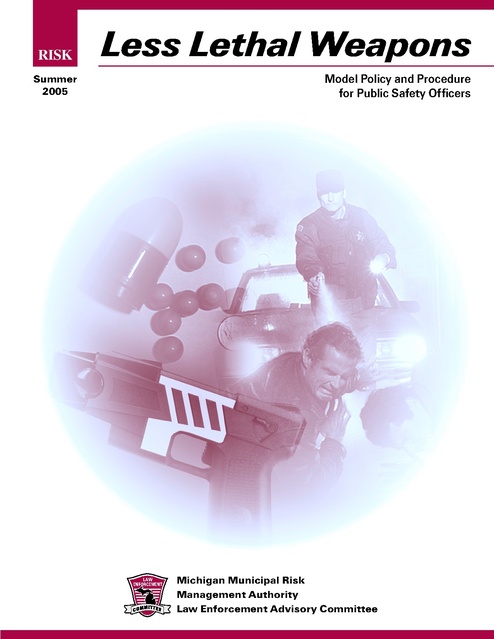
Taser Less Lethal Weapons Model Policy and Procedure 2005
Download original document:
Document text
Document text
This text is machine-read, and may contain errors. Check the original document to verify accuracy.
RISK

Less Lethal Weapons
Model Policy and Procedure
for Public Safety Officers

Summer
2005

LAW
ENFORCEMENT

Michigan Municipal Risk
Management Authority
Law Enforcement Advisory Committee

LESS LETHAL WEAPONS
MODEL POLICY AND PROCEDURE FOR PUBLIC SAFETY OFFICERS
Departments that
have a good less
lethal weapons
policy in place, and
have trained their
officers in using the
policy, can better
protect the officers
and the public.

INTRODUCTION
In today’s law enforcement climate, the use of
less lethal weapons can be an important contributor to public safety. Of course, it is important that officers know the proper guidelines for
use of less lethal weapons. This model policy and
procedure offers MMRMA Member departments
with a guide by which they can draft their own
policy for the use of less lethal weapons.
Departments that have a good policy in place,
and have trained their officers in using the
policy, can better protect the officers and the
public. While this policy and procedure is
intended as a model, it can be modified by
Member departments as needed to best serve the
needs of each community.
PURPOSE
This procedure is intended to provide general
guidelines for the use of less lethal munitions
and the use of an Electro-Muscular Disruption
(EMD) device.

DEFINITIONS
A. Less Lethal Munitions: These are types of
munitions which can be fired, launched or
otherwise propelled for the purpose of
gaining compliance, overcoming resistance or
preventing serious injury.
B. EMD: An Electro-Muscular Disruption
(EMD) device that utilizes an electrical
discharge that disrupts the body’s ability to
communicate messages from the brain to the
muscles, causing motor skill dysfunction.
Upon deployment, an air cartridge uses
compressed nitrogen to project two probes
into the targeted offender. The probes are
attached to the power source by insulated
wire leads.
C. Anti-Felony Identification Device (AFID)
(AFID):
AFID are confetti-like identification tags.
Each cartridge contains up to forty (40)
identification tags that are ejected when the
EMD is discharged. The tags contain the
serial number of the cartridge used, allowing
for identification of the officer assigned to
that cartridge.
D. Air Cartridge: A single-use item that
contains compressed nitrogen, AFID tags,
two darts and the insulated wires. It is
identified with a tamper-resistant serial
number.

APPLICATION
This order constitutes departmental policy and
is not intended to enlarge the employee’s or the
department’s civil liability in any way. It should
not be construed as the creation of a higher legal
standard of safety or care in an evidentiary sense
with respect to third party claims insofar as the
employee’s legal duty is imposed by law. Violations of this directive, if substantiated, can only
form the basis for intradepartmental administrative sanctions.
LAW
ENFORCEMENT

2

LESS LETHAL WEAPONS

E. Data Port: The EMD is designed with a data
port located on the back of the unit. This
data port allows for the downloading of the
usage record of that weapon.
F. Drive Stun: The process of utilizing the EMD
as a pain compliance technique. This is done
by activating the EMD and placing it against
an individual’s body. This can be done
without an air cartridge in place or after an
air cartridge has been deployed.

allowed to carry and/or utilize less lethal
munitions;
2. Only weapons specially designated and
marked distinctively as less lethal
munitions shall be utilized;

Less lethal munitions
will only be used after
other reasonable
efforts to control a
violent individual have
failed.

3. When stored, these specially designated
weapons shall be kept in a distinct
location, separated from other firearms.

G. Medical Contact: Contact with licensed
medical personnel by way of personal contact,
telephone, radio or other electronic means in
order to obtain an assessment or advice on
the proper course of action, treatment or
measures to be taken with the subject who
has been incapacitated by the EMD. (Consult
with the appropriate medical authority in
your jurisdiction to determine the level(s) of
expertise required for this assessment; i.e.
EMT, paramedic, nurse, physician’s assistant.)
H. Medical Clearance: The physical transportation of the subject to the most readily
available medical facility for examination,
treatment or hospitalization before incarceration back into the correctional environment.
PROCEDURE
Note: Less lethal munitions and EMDs are
additional use-of-force options and not
replacements for time, negotiations,
appropriate tactics or lethal force.
LESS LETHAL IMPACT MUNITIONS
PROCEDURE

A. Utilization Restrictions. In the absence of no
other reasonable means, an officer may
deploy less lethal munitions in the performance of their police duties under the
following conditions:
1. Only officers who have completed a
departmental-approved less lethal
munitions training program shall be

B. Conditions for Justification of Use. Less
lethal munitions will only be used after other
reasonable efforts to control a violent
individual have failed. Condition for justifying the use of less lethal munitions include,
but are not limited to:
1. When the use of less lethal munitions
would assist in the arrest of an armed
and/or violent person;
2. When the use of less lethal munitions
would assist in reducing the risk of injury
to a suspect, bystander or police officer;
3. To disperse crowds during riotous civil
disturbances; or,
4. In situations where a supervisor deems
the use of less lethal munitions necessary
to safely resolve an incident.
C. Examples of Conditions for Use Justification.
The following are examples of encounters
that may justify the use of less lethal munitions. These examples are in no way reflective of the entire spectrum of occurrences:
1. A violent subject armed with a weapon
such as a baseball bat, crowbar, shovel or
such a device or item which can be
utilized as a dangerous weapon.
2. A subject who is armed with a knife or
cutting edge.
3. Civil disturbances such as riots, violent
demonstrators, and demonstrators who fail
to disperse when commanded to do so.
4. Armed, mentally ill or developmentally
disabled individuals who may pose a risk
to themselves, others or police officers.
LAW
ENFORCEMENT

LESS LETHAL WEAPONS

3

Prior to deploying
less lethal munitions,
it shall be announced
to all officers at the
scene that less lethal
munitions are to be
deployed.

5. An unarmed, violent subject that poses
too great a risk to approach within arm’s
reach of an officer. This could apply to a
violent subject who is bleeding, biting or
endangering officers, due to the potential
of transference of bloodborne pathogens.
6. An armed suicidal person who may try to
force officers into shooting the subject so
as to facilitate their own death.
D. Conditions NOT calling for the use of less
lethal munitions:
Examples include, but are not limited to:
1. An unarmed person that is uncooperative
but does not display violent aggression; or,
2. When the use of less lethal munitions
would pose a risk to officers or bystanders.

1. Primary Target Areas. These are the
major muscle areas of mass such as the
legs, arms, buttocks, hips and thighs.
These areas offer a low probability of
causing serious injury and should be used
when incapacitation is necessary but not
time critical.
2. Secondary Impact Areas. These are areas
of the human body considered to be the
center of mass areas such as the abdomen
and chest area. These areas should be
considered for impact when an escalation
of force and immediate incapacitation is
necessary and appropriate. An increase in
the potential for death or serious physical
injury must be recognized.

1. If the situation permits, the officers should
attempt to obtain authorization from a
supervisor prior to utilizing less lethal
munitions.

3. Deadly Force Impact Areas. These are
areas of the body which when struck may
cause serious injury or death. These are
usually associated with the head, neck,
throat and groin. Intentional impacts to
these areas should be avoided unless the
use of deadly force is justified and
necessary.

2. Exception: When an imminent threat is
presented to citizens or police officers,
such force may be utilized without
command approval.

4. Impacts to the Rear of the Subject.
Impacts to the back should be avoided in all
less lethal impact munitions. Striking the
spinal area could cause permanent injury.

E. Guidelines for authorizing the use of less
lethal munitions may be as follows:

3. Application of less lethal munitions during
riotous situations shall be at the discretion
of the command officer in charge.
F. Tactical guidelines for utilization of less lethal
munitions.
1. It is recommended that, if the situation
permits, a cover officer accompany the less
lethal munitions officer.
2. Prior to deploying less lethal munitions, it
shall be announced to all officers at the
scene that less lethal munitions are to be
deployed.
3. The less lethal munitions will be delivered
to a specific target area based on the
threat and on the judgment of the officer.
LAW
ENFORCEMENT

4

G. Recommended impact areas for less lethal
munitions.

LESS LETHAL WEAPONS

H. Medical attention and subsequent responsibilities.
1. Whenever less lethal munitions are used
the officer shall, after the individual has
been secured, promptly call for medical
treatment.
2. The officer must notify the supervisor and
document the incident. It is recommended
that photographs be taken of the impact
area of the individual’s body.
3. Involved personnel shall attempt to locate
and identify any witnesses to the incident.
4. The deploying officer shall complete both
an incident report and the appropriate
USE OF FORCE report.

5. Corrections or jail officer shall be notified
that less lethal weapons had been
deployed on the subject prior to incarceration.

NOTE: If injuries requiring hospitalization or death occur, MMRMA must be
notified immediately, if incident occurs
during normal business hours. During
non-business hours, MMRMA must be
notified the next regular business day
(this text is not to be included in policy/
procedure document).
EMD PROCEDURE

B. Issuance and recording of EMD
1. All Departmental personnel shall carry
and use only the Electro-Muscular
Disruption device issued by the
Department’s administration.
2. Officers may only use Department issued
EMD cartridges.
3. A record of the cartridge serial number
shall be recorded with the issuance of
each EMD. An administration designee
should audit this log at least _____ times
each year.

The EMD is not
meant to be used in
place of deadly force.
However, there are
tactical strategies
that, when applied
properly, may allow
the EMD to be
utilized.

4. A log of EMD deployments shall be kept.

A. Deployment Considerations
1. The decision to use the EMD is based on
criteria similar to that which an officer
utilizes when selecting to deploy other
less lethal force options. The decision
must be made dependent on the actions
of the subject(s) or threat facing the
officer(s) and the totality of the circumstances surrounding the incident. The
use of the EMD must be reasonable and
necessary.
2. The EMD is not meant to be used in place
of deadly force. However, there are
tactical strategies that, when applied
properly, may allow the EMD to be
utilized.
3. The EMD should not be used without a
firearm back-up in those situations where
there is a substantial threat towards the
officer(s) or others present.
4. Prior to utilizing the EMD, officers shall
take into consideration:
a) the subject’s actions;
b) multiple subjects and the number of
officers present;
c) the skill and/or strength level (ability
to resist) of the subject(s);
d) the ability of the officer to gain
physical control of the subject; and,
e) the age of the subject.

C. Training and Certification
Only officers who have successfully completed appropriate training may carry or
utilize the EMD.
A mandatory re-certification program shall be
successfully completed annually (Administrators please note importance of this requirement)
ment).
D. Use of EMD

The EMD is an additional law enforcement
tool and is not intended to replace firearms or
replace other equipment, tools or techniques.
The EMD should be used only when it is
appropriate for the situation. The utilization
of a EMD is considered use of force and as
such, must comply with the Departmental use
of force guidelines.
LAW
ENFORCEMENT

LESS LETHAL WEAPONS

5

Immediate action
should be taken to
care for the injured,
to apprehend any
suspects and to
protect the crime
scene.

1. The EMD may be used in situations where
a subject is threatening himself, an officer
or another person and other means of
controlling the subject are not reasonable
or could cause injury to the officer, the
subject or others. Examples of these
situations include, but are not limited to:
a) To stop potentially dangerous
behavior.
b) To protect a person or officer from
injury or death.
c) To protect a subject from injuring
themselves.

if it would not endanger any civilians,
officers or the suspect.
8. The EMD has the ability to ignite flammable liquids. It shall not be deployed at
subjects who are in contact with flammables or in environments where flammables are obviously present.
Personnel should be especially aware of
this when in known clandestine lab
environments. The EMD shall NOT be
deployed in conjunction with chemical
munitions. The risk of clothing/material
ignition is significant.

d) To maintain order within a facility.
e) Situations that require gaining/
maintaining control of a subject or
situation.
2 The EMD may be used when factors
indicate the officer, offender or others
would be endangered by the use of other
force alternatives or equal force options
which may be ineffective due to the danger
existing to the officer, subject or other.
3. The body’s center of mass area should be
the target area when firing a EMD,
particularly the center mass of the back
area
area. The head and face should not be
targeted unless the appropriate level of
force can be justified.
4. The EMD should never be used punitively
or for purposes of coercion.
5. Any repeated application of the EMD must
be justified and the criteria used to justify
re-deployment shall be clearly documented
in the officers USE OF FORCE report.
6. When practical, the deploying officer
should also notify dispatch that a EMD is
going to be deployed. The deploying
officer should also notify assisting officers
that they intend to deploy a EMD.
7. If feasible, immediately prior to the use of
the EMD, the deploying officer should
announce in a loud, clear, commanding
voice, his/her intent to deploy the EMD.
This announcement should be made only
LAW
ENFORCEMENT

6

LESS LETHAL WEAPONS

9. Proper consideration and care should be
taken when deploying the EMD on
subjects who are in an elevated position
or in other circumstances where a fall may
cause substantial injury or death.
E. Responsibilities after Deployment
1. Immediate action should be taken to care
for the injured, to apprehend any suspects
and to protect the crime scene.
2. Once the subject is restrained or has
complied, the EMD should be turned off.
3. Provide that the suspect’s injuries (if any)
are appropriately treated.

4. Special care should be followed to inspect
for any secondary injuries related to the
incident.
5. EMD probes should be removed at the
earliest opportunity. These probes shall
only be removed by trained personnel or
medical personnel, keeping in mind bloodborne pathogen concerns.
6. Officers shall provide first aid following
removal of the probes by applying an
antiseptic to the probe sites as needed.
7. Medical personnel shall remove probes
located in sensitive areas such as the face,
neck, groin or breast.
8. Officers should inspect the probes after
removal to ensure that the entire probe
and probe barb has been removed. In the
event that a probe or probe barb has
broken off, the subject should be provided
with the appropriate medical attention to
facilitate the removal of the object.
9. Medical contact may be made to further
assess the condition of the subject. If
conditions warrant, the subject shall be
transported to the nearest medical facility
for medical clearance.
10. Medical treatment shall not be refused to
a subject requesting it.
11. Photographs should be taken of the probe
impact sites and any other related injuries.
12. Probes that have been removed from the
skin shall be treated as biohazard sharps
and placed as evidence within an appropriate container.
13. Officers shall attempt to locate the AFID
tags and place those into evidence. It is
recommended that at least five (5) of
these tags be retrieved and placed into
evidence with the expended cartridge.
14. Involved personnel shall attempt to locate
and identify any witnesses to the incident.
15. The deploying officer shall complete both
an incident report and the appropriate
USE OF FORCE report.

16. Corrections or jail officer shall be notified
that the EMD had been deployed on the
subject prior to incarceration.

CAUTIONARY ADVISORY
It is recommended that agencies consider
deploying the EMD only when the subject’s
actions constitute active aggression or when
the officer believes that lower forms of empty
hand controls will be inadequate or unsafe
(based on specific facts and circumstances
known to the officer at the time force is used1).

Before adopting this
policy and procedure,
departments must
evaluate their specific
types of less lethal
munitions and revise
the appropriate
nomenclature and
strategies.

Before adopting this policy and procedure,
departments must evaluate their specific types of
less lethal munitions and revise the appropriate
nomenclature and strategies.
NOTE: Use of force reports outlining the
details of the EMD deployment must be sent to
Michigan Municipal Risk Management Authority
(MMRMA) within seven (7) calendar days.
In the event that the use of force incident
involving the EMD results in injuries requiring
hospitalization, MMRMA shall receive an
immediate telephone notice (next business day if
incident occurred during non-business hours).

If death occurs, MMRMA must be notified
immediately during business hours or through
its emergency 24-hour telephone line, 1-800-2431324 (This note is not to be included in your
department’s protocol).
1 MCOLES Newsletter, Michigan’s New EMD Law – Are You
Prepared?, Volume I, Issue 8, May 2003, Michigan Commission On
Law Enforcement Standards, 7426 North Canal Road, Lansing, MI.
48913

CONCLUSION
Crafting a policy and procedure for the use of
less lethal weapons can help MMRMA Member
departments protect their officers and their
communities. This model policy and procedure is
an excellent starting point. If you have any
questions or need additional assistance, please
contact the MMRMA Risk Control Department at
734-513-0300.
LAW
ENFORCEMENT

LESS LETHAL WEAPONS

7

LAW ENFORCEMENT ADVISORY COMMITTEE MEMBERS

LAW
ENFORCEMENT

Members
Chief James Bjorne
Ishpeming Police Department

Undersheriff Scott Celello
Dickinson County Sheriff's Dept.

Sheriff Michael Lovelace
Undersheriff Jack Schneider
Captain David Lemire
Marquette County Sheriff's Dept.

Chief William Corbett
Port Huron Police Dept.

Undersheriff Ed Oswald
Delta County Sheriff's Dept.

Sheriff David Cromell
Undersheriff Robert Hughes
Alger County Sheriff's Dept.

Sheriff Larry Sanders
Gogebic County Sheriff's Dept.

Sheriff Dwain Dennis
Ionia County Sheriff's Dept.
Chief Pete Flaminio
Iron Mountain Police Dept.
Deputy Chief James Lazar
Dearborn Heights Police Dept.

Chief Robert Stevenson
Livonia Police Dept.
Chief Thomas Tiderington
Plymouth Township Police Dept.
Chief John Werth
Northville Township Police Dept.

Sheriff Gary Finstrom
Wexford County Sheriff's Dept.

Sheriff Gene Wriggelsworth
Major Alan Spyke
Ingham County Sheriff's Dept.

Chief James Hansen
Escanaba Police Dept.

Chris Johnson
Johnson, Rosati, LaBarge, Aseltyne & Field
MMRMA Committee Liaisons
Mike Bertha, Risk Consultant
Kevin Denecke, Risk Consultant
William Page, Risk Consultant

A publication for members of

RISK

Michigan Municipal
Risk Management Authority
14001 Merriman Road
Livonia, MI 48154
(734) 513-0300
www.mmrma.org