Skip navigation
PYHS - Header

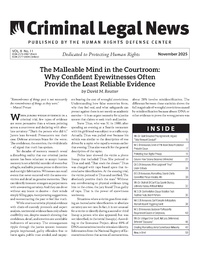
Criminal Legal News: November, 2025

Issue PDF
Volume 8, Number 11

In this issue:

  1. The Malleable Mind in the Courtroom: Why Confident Eyewitnesses Often Provide the Least Reliable Evidence (p 1)
  2. Fourth Circuit: Government Breached Plea Agreement by Successfully Arguing for Sentencing Enhancement Based on “Total Relevant Conduct” Not Stipulated to in Plea Agreement (p 15)
  3. Michigan Supreme Court Announces Smell of Marijuana Alone Is No Longer Sufficient to Establish Probable Cause to Search Vehicle (p 17)
  4. Protecting Your Digital Privacy (p 19)
  5. How Tyranny Becomes Entrenched: 9/11 and the Police State’s Endless Power Grabs (p 22)
  6. Third Circuit: Where Prosecutor “Flooded” Jury Trial With Evidence of Defendant’s Prior Bad Acts, Counsel Was Constitutionally Ineffective in Not Seeking Contemporaneous Limiting Instructions and Not Objecting When Evidence Went Beyond Limited Purpose – (p 25)
  7. California Supreme Court Announces Judgment Not Considered Final Under Estrada for Retroactive Application of Amended Gang Enhancement Statute When Conviction Affirmed on Appeal but Sentencing Issues Remain Pending Following Remand (p 28)
  8. Idaho Supreme Court Announces Warrantless Search of Civilly Committed Individual Violates Fourth Amendment (p 30)
  9. Ninth Circuit Reaffirms Longstanding Precedent That District Court Cannot Sua Sponte Dismiss Untimely Habeas Corpus Petition Without Giving Petitioner Prior Notice and Opportunity to Respond (p 32)
  10. California Court of Appeal Reverses Superior Court’s Denial of Motion to Vacate Conviction Where Defendant Established His Failure to Understand the Immigration Consequences of Plea (p 34)
  11. Maine Supreme Judicial Court Vacates Conviction Based on Confrontation Clause Where Toxicologist Testified About Toxicology Tests Performed by Others, Which SCOTUS Rejected in Smith v. Arizona (p 36)
  12. Massachusetts Supreme Judicial Court Announces Police Cannot Execute Anticipatory Warrant Absent Triggering Event Regardless of Whether Factual Allegations in Warrant Affidavit Independently Give Rise to Probable Cause to Search, Thereby Providing Greater (p 38)
  13. Michigan Supreme Court Announces Guidance on Standards for Search Warrants of Cellphones to Satisfy Particularity Requirement of Fourth Amendment That “Reasonably Direct” Search to Uncovering Evidence of Criminal Activity Identified in Warrant (p 40)
  14. DHS Has Been Quietly Collecting DNA From U.S. Citizens for Years, Funneling It Into FBI’s CODIS Without Oversight (p 43)
  15. Ninth Circuit Holds Untruthful Responses to Questions Government Is Not Permitted to Ask on Visa Application Is Still Fraud if Responses Could Have Influenced Decision to Grant Request for Visa (p 44)
  16. NYC Murder Convictions Vacated After Withheld Evidence Reveals “Factually Impossible” Coerced Confession (p 46)
  17. Sixth Circuit: Erlinger Error Requires Resentencing Where Government Cannot Prove Beyond Reasonable Doubt That Jury Would Find Prior Offenses Committed on Different “Occasions” (p 48)
  18. Drones and License Plate Readers: Police Creating Warrantless Aerial Surveillance Networks (p 49)
  19. NEWS IN BRIEF (p 50)

The Malleable Mind in the Courtroom: Why Confident Eyewitnesses Often Provide the Least Reliable Evidence

by David M. Reutter

“Remembrance of things past is not necessarily the remembrance of things as they were.”

– Marcel Proust

When jurors weigh evidence in a criminal trial, few types of evidence are more persuasive than a witness pointing across a courtroom and declaring with …

Fourth Circuit: Government Breached Plea Agreement by Successfully Arguing for Sentencing Enhancement Based on “Total Relevant Conduct” Not Stipulated to in Plea Agreement

by Douglas Ankney

The United States Court of Appeals for the Fourth Circuit held that the Government breached its plea agreement with Dehaven Darnell Craig when it successfully argued for sentencing enhancements based on “total relevant conduct” to which the parties had not stipulated in the plea agreement.

Michigan Supreme Court Announces Smell of Marijuana Alone Is No Longer Sufficient to Establish Probable Cause to Search Vehicle

by Sagi Schwartzberg

The Supreme Court of Michigan held that the smell of marijuana, by itself, does not establish probable cause to search a motor vehicle. In doing so, the Court overturned People v. Kazmierczak, 605 N.W.2d 667 (Mich. 2000), which held that “the smell of marijuana alone …

Protecting Your Digital Privacy

by Anthony W. Accurso

In an era of expanding government surveillance, protecting your digital privacy is more critical than ever. This article offers practical steps to safeguard your data from government and corporate surveillance. As digital threats evolve in 2025, with increasing use of AI for tracking and …

How Tyranny Becomes Entrenched: 9/11 and the Police State’s Endless Power Grabs

by John & Nisha Whitehead

This column was originally published on September 9, 2025, on Rutherford.org. It has been reprinted with permission.


“The greatest tyrannies are always perpetuated in the name of the noblest causes.” – Thomas Paine


They said it was …

Third Circuit: Where Prosecutor “Flooded” Jury Trial With Evidence of Defendant’s Prior Bad Acts, Counsel Was Constitutionally Ineffective in Not Seeking Contemporaneous Limiting Instructions and Not Objecting When Evidence Went Beyond Limited Purpose –

by Douglas Ankney

The United States Court of Appeals for the Third Circuit ruled that where a state prosecutor flooded the jury trial with evidence of defendant Kelvin Rosa’s prior bad acts, his defense attorney was ineffective for failing to seek contemporaneous limiting instructions and for failing to …

California Supreme Court Announces Judgment Not Considered Final Under Estrada for Retroactive Application of Amended Gang Enhancement Statute When Conviction Affirmed on Appeal but Sentencing Issues Remain Pending Following Remand

by Sagi Schwartzberg

The Supreme Court of California held that a defendant was entitled to retroactive application of an amended ameliorative statute because a criminal case’s judgment is not final until the entire prosecution, including the sentencing phase, is complete.

Background

In October 2014, Oscar Lopez …

Idaho Supreme Court Announces Warrantless Search of Civilly Committed Individual Violates Fourth Amendment

by Anthony W. Accurso

In a case of first impression, the Supreme Court of Idaho held that the warrantless search of a patient who was in civil protective custody violated the Fourth Amendment because the State failed to establish that the search fell within a recognized exception or …

Ninth Circuit Reaffirms Longstanding Precedent That District Court Cannot Sua Sponte Dismiss Untimely Habeas Corpus Petition Without Giving Petitioner Prior Notice and Opportunity to Respond

by Douglas Ankney

The United States Court of Appeals for the Ninth Circuit reaffirmed its longstanding precedent that a District Court cannot sua sponte dismiss an untimely petition for a writ of habeas corpus without giving the petitioner prior notice and an opportunity to respond.

Background

California Court of Appeal Reverses Superior Court’s Denial of Motion to Vacate Conviction Where Defendant Established His Failure to Understand the Immigration Consequences of Plea

by Douglas Ankney

The Court of Appeal of California, Second Appellate District, reversed a superior court’s denial of Misael Padron’s motion to vacate his conviction for carjacking because he failed to “meaningfully understand, defend against, or knowingly accept” the immigration consequences of his plea.

Background

In …

Maine Supreme Judicial Court Vacates Conviction Based on Confrontation Clause Where Toxicologist Testified About Toxicology Tests Performed by Others, Which SCOTUS Rejected in Smith v. Arizona

by Douglas Ankney

The Supreme Judicial Court of Maine vacated Rochelle Gleason’s conviction for aggravated trafficking of a scheduled drug that caused the death of a person after applying the holding of Smith v. Arizona, 602 U.S. 779 (2024), in which the United States Supreme Court rejected the …

Massachusetts Supreme Judicial Court Announces Police Cannot Execute Anticipatory Warrant Absent Triggering Event Regardless of Whether Factual Allegations in Warrant Affidavit Independently Give Rise to Probable Cause to Search, Thereby Providing Greater

by Douglas Ankney

The Supreme Judicial Court of Massachusetts held that “art. 14 of the Massachusetts Declaration of Rights prohibits the police from executing an anticipatory search warrant absent compliance or equivalent compliance with the future triggering event, regardless of whether the factual allegations in the warrant affidavit …

Michigan Supreme Court Announces Guidance on Standards for Search Warrants of Cellphones to Satisfy Particularity Requirement of Fourth Amendment That “Reasonably Direct” Search to Uncovering Evidence of Criminal Activity Identified in Warrant

by Anthony W. Accurso

The Supreme Court of Michigan held that a search warrant was insufficiently particular in violation of the Fourth Amendment because it permitted investigators to search “any and all data” on the defendant’s cellphone with the only instruction limiting the scope of the search was …

DHS Has Been Quietly Collecting DNA From U.S. Citizens for Years, Funneling It Into FBI’s CODIS Without Oversight

by Jo Ellen Nott

The Department of Homeland Security (“DHS”) is facing scrutiny over its unauthorized practice of harvesting DNA from nearly 2,000 U.S. citizens, including children, and submitting their genetic profiles to the FBI’s Combined DNA Index System (“CODIS”), as reported by Wired. This large-scale expansion, which …

Ninth Circuit Holds Untruthful Responses to Questions Government Is Not Permitted to Ask on Visa Application Is Still Fraud if Responses Could Have Influenced Decision to Grant Request for Visa

by Douglas Ankney

The United States Court of Appeals for the Ninth Circuit held that the untruthful responses of Namrata Patnaik and Kartiki Parekh on visa applications could still be found by a jury to be fraud if the government relied on those responses when deciding to issue …

NYC Murder Convictions Vacated After Withheld Evidence Reveals “Factually Impossible” Coerced Confession

by Jo Ellen Nott

A Manhattan judge vacated the convictions of Brian Boles and Charles Collins for a 1994 Harlem murder, the Innocence Project reported. Judge Ruth Pickholz ended the nearly three-decade ordeal, which stemmed from a coerced and factually impossible confession from Brian Boles, who was just …

Sixth Circuit: Erlinger Error Requires Resentencing Where Government Cannot Prove Beyond Reasonable Doubt That Jury Would Find Prior Offenses Committed on Different “Occasions”

by Anthony W. Accurso

The United States Court of Appeals for the Sixth Circuit held that the U.S. District Court for the Western District of Tennessee erred by applying an ACCA enhancement at sentencing because the District Court, not a jury, determined that the relevant offenses occurred on …

Drones and License Plate Readers: Police Creating Warrantless Aerial Surveillance Networks

by Jo Ellen Nott

Police adoption of drone-as-first-responder (“DFR”) programs is increasing and now integrating with automated license plate reader (“ALPR”) technology to create a potent new form of surveillance, the Electronic Frontier Foundation (“EFF”) reports. Companies like Flock Safety are marketing their drones, specifically the Aerodome, as …

NEWS IN BRIEF

California: Former Stanislaus County Sheriff’s Deputy Matthew Joseph Dessert, 42, was sentenced to nine years in prison on August 8, 2025, for sexually abusing his teenage daughter. According to The Modesto Bee, County Superior Court Judge Jeff Mangar said that the lawman violated his office’s trust in the …




The Habeas Citebook: Prosecutorial Misconduct Side
PLN Subscribe Now Ad 450x450
Federal Prison Handbook - Side