by Richard Resch
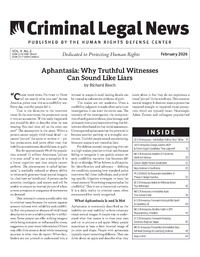
"Close your eyes. Picture it. Now tell me exactly what you saw.” Across America, police treat this as a credibility test. Every day, truthful people fail it.
That is the detective in the interview room. In the courtroom, the prosecutor turns it into an …
by David Kim
The Supreme Court of California unanimously held that the rule established in People v. Vargas, 328 P.3d 1020 (Cal. 2014), requiring a trial court to dismiss one strike when two prior strike convictions arise from a single criminal act, applies equally when the defendant’s single …
by Richard Resch
In a case of first impression, the United States Court of Appeals for the First Circuit held that when a juvenile offender’s mandatory life-without-parole sentence is modified to life with the possibility of parole following a state court determination that the original sentence was unconstitutional, …
by Matt Clarke
In a case of first impression, the Supreme Judicial Court of Massachusetts held that a defendant’s lawful exercise of self-defense against an assailant may excuse the killing of an unintended victim, such as an innocent bystander. The Court adopted transferred intent self-defense as part of …
by David Kim
The Supreme Judicial Court of Massachusetts held that the reasonableness of global positioning system (“GPS”) monitoring as a condition of probation depends in part on its duration, and thus a judge conducting the individualized determination required by Commonwealth v. Feliz, 119 N.E.3d 700 (Mass. 2019), …
by Richard Resch
In the companion to this Column, “When AI Invents the Pixels,” published in the January 2026 issue of CLN, we explored the dangers of prosecutors introducing AI-enhanced video as substantive evidence at trial. We discussed how some generative upscaling tools can create “hallucinations,” plausible but …
by David Kim
The California Court of Appeal, Second Appellate District, ruled that trial courts possess inherent authority to correct unauthorized sentences whenever the issue is presented, regardless of whether the original judgment has become final or been affirmed on appeal. The Court rejected the trial court’s conclusion …
by David Kim
When a 4-month-old girl known to the public only as “Baby Kate” vanished from a small Michigan town in 2011, detectives eventually found themselves staring not at a crime-scene photograph or a cell-tower map, but at a smear of dried mud on the bottom of …
by David Kim
In an issue of first impression, the Opinion Announcing the Judgment of the Court (“OAJC”) concluded that a person who conducts general, unprotected internet searches has no reasonable expectation of privacy in the records generated by those searches under either the Fourth Amendment or Article …
by David Kim
The Supreme Court of Delaware held that when defense counsel moves to withdraw after a client expresses a desire to withdraw a plea, the trial court must resolve counsel’s motion before addressing the plea-withdrawal request, because plea-withdrawal proceedings are a critical stage at which the …
by Sagi Schwartzberg
The Supreme Court of Maryland held that when a defendant’s term of confinement comprises multiple consecutive sentences and one or more underlying convictions is vacated while at least one valid sentence remains, Maryland Code Ann., Criminal Procedure Article (“CP”) § 6-218(d) requires that the defendant …
by David Kim
The Supreme Court of Iowa held that generalized expert testimony concerning psychological factors affecting eyewitness identification accuracy and witness confidence should “ordinarily” be admitted when a criminal prosecution relies in part or whole on eyewitness testimony. Providing the first guidance on the boundaries of trial …
by Jo Ellen Nott
A bipartisan provision tucked into the recently signed National Defense Authorization Act of 2025 has opened new federal funding streams for law enforcement agencies seeking to expand their drone programs, a development hailed by police advocates but met with skepticism by civil liberties groups.
…
by Douglas Ankney
In a case involving an issue of first impression in Utah, the Supreme Court of Utah adopted a two-step analytical framework for evaluating prejudice when both Brady and Napue violations are present, drawing from approaches utilized by several United States Courts of Appeals. Applying the …
by Richard Resch
In a case presenting an issue of first impression in the Circuit, the United States Court of Appeals for the Eighth Circuit held that a presidential commutation of a defendant’s sentence does not render moot the defendant’s pending challenge to the original judicial sentence, addressing …
Loaded on
Jan. 1, 2026
published in Criminal Legal News
February, 2026, page 49
Alabama: WABM in Birmingham reported that former Eleventh Judicial Circuit Presiding Judge Gilbert P. Self, 64, was sentenced to 51-1/2 years in state prison on December 17, 2025, following his conviction the previous month on public corruption charges. As CLN reported, a jury found him guilty of repeatedly …