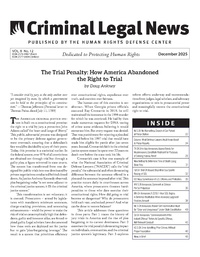
by Doug Ankney
“I consider trial by jury as the only anchor ever yet imagined by man, by which a government can be held to the principles of its constitution.” —Thomas Jefferson (Personal letter to Thomas Paine, dated July 11, 1789)
The American criminal justice system is …
by Sagi Schwartzberg
The Supreme Court of New Jersey held that the automobile exception to the warrant requirement did not apply when police searched a vehicle parked in a police barracks parking lot after arresting the driver for DWI, removing the passenger, obtaining the keys, and subjecting the …
by Richard Resch
Police departments nationwide are racing to adopt artificial intelligence that transcribes body-camera footage, translates witness statements, and drafts investigative narratives. But these tools introduce profound risks to factual accuracy and due process that defense attorneys must challenge at every stage of a case.
A …
by Matthew Clarke
The Court of Criminal Appeals of Texas held that defendants charged with fine-only Class C misdemeanors who have posted appeal bonds to perfect their de novo appeals are “restrained” within the meaning of Texas’s habeas corpus statutes and therefore may seek pretrial habeas relief.
…
by Jo Ellen Nott
Texas A&M AgriLife Research has developed a new forensic tool that could revolutionize how investigators estimate time of death. Researchers have devised a technique using infrared light and machine learning to determine the sex of blow fly larvae found on human remains, a critical …
by Douglas Ankney
The United States Court of Appeals for the First Circuit affirmed the U.S. District Court for the District of Puerto Rico’s grant of 28 U.S.C. § 2254 habeas relief, holding that the Commonwealth intelligently waived any § 2244(d)(1)(C) timeliness defense by knowingly omitting it from …
by Jo Ellen Nott
Immigration and Customs Enforcement (“ICE”), backed by new legislation passed in July 2025 called the One Big Beautiful Bill Act, is engaging in a never-before-seen expansion of mass surveillance technology. This technology was originally intended to seek and find undocumented immigrants but now is …
by Douglas Ankney
The Supreme Court of Wyoming reversed a defendant’s sexual abuse conviction, holding that the prosecutor’s opening statement that the defendant “declined” to speak with police was an improper comment on his constitutional right to silence. In doing so, the Court clarified that such a comment …
by Sagi Schwartzberg
The United States Court of Appeals for the Eighth Circuit held that a 28 U.S.C. § 2255 motion was timely, concluding that the one-year statute of limitations does not begin to run from an initial judgment that defers restitution but from the subsequent amended judgment …
by David Kim
The Supreme Judicial Court of Maine held that waiver of the privilege against compelled self-incrimination under article I, section 6 of the Maine Constitution must be “clear and unequivocal,” and under this standard, the defendant did not waive his privilege because his responses during the …
by David Kim
The United States Court of Appeals for the Third Circuit held that the phrase “commencement of the instant offense” for calculating the 10-year criminal history look-back period under U.S. Sentencing Guidelines (“U.S.S.G.”) § 4A1.2(e)(2) unambiguously refers to the start of the specific offense of conviction, …
by Sagi Schwartzberg
The Supreme Court of Kansas held that a trial court erred by admitting evidence of uncharged, suspected child abuse that occurred over the period of two months preceding a baby’s death under K.S.A. 2022 Supp. 60-455 (governing prior acts evidence) because the State failed to …
Loaded on
Nov. 15, 2025
published in Criminal Legal News
December, 2025, page 49
Alabama: The U.S. District Court for the Northern District of Alabama sentenced former Centre Police Department (CPD) Off. Michael Kilgore, 41, to four years in federal prison on October 8, 2025, after he pleaded guilty to conspiracy to distribute methamphetamine in a wild evidence-planting scheme to advance his …