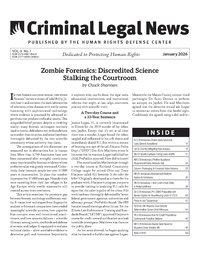
by Chuck Sharman
In the American courtroom, the word “forensic” carries a veneer of infallibility. Jurors hear it and envision the sleek laboratories of television crime dramas with sterile rooms humming with sophisticated technology, where evidence is processed by advanced algorithms that produce irrefutable results. This misguided belief …
by David Kim
he Supreme Court of New Jersey affirmed the exclusion of expert testimony regarding Shaken Baby Syndrome/Abusive Head Trauma (“SBS/AHT”) in cases alleging shaking without impact, holding that the State failed to demonstrate the necessary general acceptance under the Frye standard. The Court reasoned that because …
by Douglas Ankney
The United States Court of Appeals for the First Circuit vacated Dionel Guía-Sendeme’s sentence and remanded for resentencing, holding that the U.S. District Court for the District of Puerto Rico erred in its mitigating role analysis under U.S. Sentencing Guidelines § 3B1.2 by limiting the …
by David Kim
The United States Court of Appeals for the Ninth Circuit reversed the U.S. District Court for the District of Nevada’s dismissal of a federal habeas petition as untimely, holding that equitable tolling applied under the Antiterrorism and Effective Death Penalty Act of 1996 (“AEDPA”) where …
by Sagi Schwartzberg
In an issue of first impression, the Supreme Court of Maryland held that under the plain language of the Public Defender Act (“Act”), when the Office of the Public Defender (“OPD”) authorizes an attorney to file a petition for a writ of certiorari and the …
by Anthony W. Accurso
The United States Court of Appeals for the Ninth Circuit affirmed the exclusion of the factual basis from the defendant’s plea agreement, holding that the agreement’s waiver of Federal Rule of Evidence 410 (“Rule 410”) protections was never triggered. The Court reasoned that because …
by Richard Resch
When prosecutors offer “enhanced” surveillance footage or body-camera video, defense counsel must understand what enhancement actually means. Traditional forensic methods such as adjusting brightness, applying contrast filters, or using established interpolation algorithms like nearest-neighbor or bi-cubic scaling operate directly on the captured data. Even when …
by Jo Ellen Nott
A federal jury in New York awarded the estate of Darryl Boyd a record-breaking $80 million on November 19, 2025, for the more than 27 years he spent incarcerated following his wrongful 1977 murder conviction. Boyd, who died of pancreatic cancer in February 2025 …
by David Kim
The United States Court of Appeals for the Ninth Circuit held that while the abandonment doctrine applies to cellphones, courts must analyze the intent to abandon the physical device separately from the intent to abandon its data – and should not reflexively conflate the two. …
by David Kim
The United States Court of Appeals for the Seventh Circuit held that the one-year time limit for filing a sentence-reduction motion under Federal Rule of Criminal Procedure 35(b)(1) is a nonjurisdictional claim-processing rule that may be waived, overruling its decision in United States v. McDowell, …
by Sagi Schwartzberg
In resolving a conflict among Courts of Appeal, the Supreme Court of California held that defendants convicted of provocative act murder before its 2009 decision in People v. Concha, 218 P.3d 660 (Cal. 2009), are not categorically ineligible for resentencing under Cal. Pen. Code § …
by Sagi Schwartzberg
Flock, a private police surveillance company, has built an enormous nationwide database and license plate tracking system which collects records of Americans’ travel and makes this vast database available to law enforcement across the country. This system allows police to search the nationwide movement of …
by Michael Dean Thompson
Every day new digital tools generate massive new piles of data for law enforcement to winnow for grains of truth. With each new tool comes a new need for expertise to know when the proffered grain is good data or virtual chaff. The challenge …
by Richard Resch
In a per curiam opinion, the Supreme Court of the United States reversed a divided Mississippi Supreme Court decision, holding that under the Sixth Amendment’s Confrontation Clause, a trial court may not deny a defendant his right to face-to-face confrontation with a child witness simply …
by Matthew Clarke
Addressing an issue of first impression, the Supreme Court of Pennsylvania held that a defendant held on a probation detainer after posting bail on new charges is entitled to credit for that time against his new sentence where the detainer was triggered by the same …
by Jo Ellen Nott
Homeowners are often left financially devastated and without clear legal recourse after police raids cause extensive property damage, forcing them to bear costs that many say should be the public’s responsibility.
The case of Vicki Baker, whose Texas home was ruined by a …
by David Kim
The Supreme Court of Minnesota held that a buccal swab collected from a criminal defendant pursuant to a district court discovery order under Minnesota Rule of Criminal Procedure 9.02, subdivision 2(1)(f), rather than a search warrant, constituted an unconstitutional search requiring suppression of the resulting …
Loaded on
Dec. 15, 2025
published in Criminal Legal News
January, 2026, page 50
Alabama: In a rare victory for ethics enforcement in the Cotton State, a Lauderdale County jury returned a guilty verdict on November 7, 2025, against a former state judge accused of public corruption. According to the Alabama Political Reporter, Gilbert Porterfield Self, Sr., former presiding judge of the …