Skip navigation
CLN bookstore

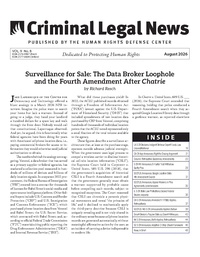
Criminal Legal News: August, 2026

Issue PDF
Volume 9, Number 8

In this issue:

  1. Surveillance for Sale: The Data Broker Loophole and the Fourth Amendment After Chatrie (p 1)
  2. Louisiana Supreme Court Declares Unconstitutional Statute Stripping Courts of Authority to Order Payment of Indigent Defense Expert Funds, Holding the Law Infringes on Judiciary’s Constitutionally Granted Jurisdiction Over Felony Cases (p 20)
  3. California Court of Appeal Announces Defendants Who Exercise Right to Jury Trial on Aggravating Circumstances Are Entitled to Closing Argument by Counsel on Those Factors (p 21)
  4. Retroactive Guideline Amendments: The Narrow Path to a Federal Sentence Reduction (p 23)
  5. SCOTUS Holds Federal Habeas Court May Not Consider Post-Trial DNA Evidence That Was Never Presented to Jury When Assessing Whether False Informant Testimony Influenced Verdict (p 28)
  6. Supreme Court of Appeals of West Virginia Announces Six-Factor Test for Evaluating Presentence Motions to Withdraw Guilty Pleas Under Rule 32(e), Holds Binding Plea Agreement Does Not Extinguish Defendant’s Ability to Seek Withdrawal (p 29)
  7. SCOTUS Announces Accessing Google Location History Data Constitutes a Fourth Amendment Search, Holding That Neither Brief Duration Nor Third-Party Storage Negates Reasonable Expectation of Privacy in Cellphone Location Information (p 31)
  8. SCOTUS Announces Appeal Waivers in Plea Agreements Unenforceable When Enforcement Would Produce a Miscarriage of Justice, Adopting Majority Circuit Approach (p 35)
  9. Illinois Supreme Court Announces State Common Law and Statutory Issue Preclusion Protections Exceed Federal Double Jeopardy Protections, Holding Currier v. Virginia Does Not Constrain Illinois’s Independent Doctrine (p 36)
  10. California Supreme Court Announces Amended § 1170(b) Applies Retroactively to Plea-Bargained Upper Term Sentences (p 37)
  11. SCOTUS Holds Mississippi Supreme Court Unreasonably Applied Batson and Unreasonably Found Waiver Where Trial Court Skipped Third Step of Inquiry (p 39)
  12. Supreme Court of Maryland Holds Officer Lacked Reasonable Suspicion for Traffic Stop Based on Acquaintance’s Tip Reporting Innocent Conduct, Reaffirming That “High-Crime Area” Testimony Must Be Particularized (p 40)
  13. Hawai’i Supreme Court Holds Trial Court Failed to Consider HAWJIC 3.19A Factors and “Effect of Suggestiveness on Reliability” When Evaluating Field Show-Up Identifications (p 42)
  14. Passive Data Transforms Smart Devices Into Covert Witnesses in a Silent Surveillance State (p 43)
  15. Michigan Supreme Court Announces Betts Decision Invalidating 2011 SORA as Ex Post Facto Punishment Applies Retroactively to Defendants on Collateral Review (p 44)
  16. South Carolina Supreme Court Announces Formal Adoption of Fourth Circuit’s Three-Step Cheek Framework for Evaluating Improper Third-Party Contacts With Jurors Under Remmer, Reverses Murdaugh Murder Convictions, and Overrules Ethier Regarding Juror Testim (p 46)
  17. Safety of “The Wrap” Restraint Device Questioned Amid Fatalities and Criticism From Medical Experts (p 47)
  18. Oregon Supreme Court Announces Witness Competency Under OEC 601 Depends on General Capacity to Be a Witness, Not Ability to Recall a Specific Fact (p 48)
  19. NEWS IN BRIEF (p 49)

Surveillance for Sale: The Data Broker Loophole and the Fourth Amendment After Chatrie

by Richard Resch

Jake Laperruque of the Center for Democracy and Technology offered a blunt analogy in a March 2026 NPR interview. Imagine the police want to search your home but lack a warrant. Instead of going to a judge, they hand your landlord a hundred dollars for …

Louisiana Supreme Court Declares Unconstitutional Statute Stripping Courts of Authority to Order Payment of Indigent Defense Expert Funds, Holding the Law Infringes on Judiciary’s Constitutionally Granted Jurisdiction Over Felony Cases

by David M. Reutter

The Supreme Court of Louisiana affirmed a district court’s ruling that La. R.S. 15:168(E)(3), which declares that no court “shall have jurisdiction to order the payment of any funds administered by the office or district public defender for expert witnesses, or for any other …

California Court of Appeal Announces Defendants Who Exercise Right to Jury Trial on Aggravating Circumstances Are Entitled to Closing Argument by Counsel on Those Factors

by Douglas Ankney

In a matter of first impression, the California Court of Appeal, Second Appellate District, held that a trial court must permit a defendant who exercises the right to a jury trial on aggravating circumstances under Penal Code § 1170(b)(2) the opportunity to argue to the …

Retroactive Guideline Amendments: The Narrow Path to a Federal Sentence Reduction

by Richard Resch

When the United States Sentencing Commission lowers a Guideline range, the revision ordinarily applies only to defendants sentenced after the effective date. For the thousands of people already serving sentences calculated under the old, harsher Guideline range, the change might seem irrelevant. But a motion …

SCOTUS Holds Federal Habeas Court May Not Consider Post-Trial DNA Evidence That Was Never Presented to Jury When Assessing Whether False Informant Testimony Influenced Verdict

by Douglas Ankney

In a per curiam opinion, the Supreme Court of the United States vacated the judgment of the U.S. Court of Appeals for the Eleventh Circuit affirming the denial of federal habeas relief to Florida death row prisoner Gary Richard Whitton, holding that the Court of …

Supreme Court of Appeals of West Virginia Announces Six-Factor Test for Evaluating Presentence Motions to Withdraw Guilty Pleas Under Rule 32(e), Holds Binding Plea Agreement Does Not Extinguish Defendant’s Ability to Seek Withdrawal

by Douglas Ankney

The Supreme Court of Appeals of West Virginia vacated a circuit court order that accepted a defendant’s 20-year-old guilty plea and imposed sentence under a binding plea agreement, holding that the circuit court erred by concluding the agreement’s binding nature eliminated its discretion to allow …

SCOTUS Announces Accessing Google Location History Data Constitutes a Fourth Amendment Search, Holding That Neither Brief Duration Nor Third-Party Storage Negates Reasonable Expectation of Privacy in Cellphone Location Information

by Richard Resch

The Supreme Court of the United States held that police officers conducted a Fourth Amendment search when they acquired a criminal suspect’s Google Location History data through a geofence warrant, concluding that individuals maintain a reasonable expectation of privacy in records documenting their cellphone’s whereabouts. …

SCOTUS Announces Appeal Waivers in Plea Agreements Unenforceable When Enforcement Would Produce a Miscarriage of Justice, Adopting Majority Circuit Approach

by David Kim

The Supreme Court of the United States held that a criminal defendant’s agreement not to appeal a sentence is unenforceable when enforcement would produce a miscarriage of justice. Defining the threshold, the Court stated that a waiver may be set aside only where the sentence …

Illinois Supreme Court Announces State Common Law and Statutory Issue Preclusion Protections Exceed Federal Double Jeopardy Protections, Holding Currier v. Virginia Does Not Constrain Illinois’s Independent Doctrine

by David Kim

The Supreme Court of Illinois unanimously held that issue preclusion under both Illinois common law and § 3-4(b)(2) of the Criminal Code of 2012 affords criminal defendants protections surpassing those guaranteed by the federal Double Jeopardy Clause. The Court rejected the State’s contention that Currier …

California Supreme Court Announces Amended § 1170(b) Applies Retroactively to Plea-Bargained Upper Term Sentences

by Douglas Ankney

In resolving a split among the Courts of Appeal, the Supreme Court of California unanimously held that defendants who agreed to upper term sentences as part of plea bargains may seek the retroactive benefit of amended Penal Code § 1170, subdivision (b), which requires that …

SCOTUS Holds Mississippi Supreme Court Unreasonably Applied Batson and Unreasonably Found Waiver Where Trial Court Skipped Third Step of Inquiry

by David Kim

The Supreme Court of the United States held that the Mississippi Supreme Court unreasonably applied Batson v. Kentucky, 476 U.S. 79 (1986), and unreasonably determined that a capital defendant waived his opportunity to rebut the prosecutor’s asserted race-neutral reasons for peremptory strikes against four Black …

Supreme Court of Maryland Holds Officer Lacked Reasonable Suspicion for Traffic Stop Based on Acquaintance’s Tip Reporting Innocent Conduct, Reaffirming That “High-Crime Area” Testimony Must Be Particularized

by David M. Reutter

The Supreme Court of Maryland unanimously reversed the judgment of the Appellate Court, holding that a police officer lacked reasonable suspicion under the totality of the circumstances to stop Xavier S. Kopp’s vehicle. The Court concluded that a tip from the officer’s personal acquaintance …

Hawai’i Supreme Court Holds Trial Court Failed to Consider HAWJIC 3.19A Factors and “Effect of Suggestiveness on Reliability” When Evaluating Field Show-Up Identifications

by David Kim

The Supreme Court of Hawai’i unanimously held that a circuit court erred by failing to consider the factors listed in Hawai’i Pattern Jury Instructions – Criminal (“HAWJIC”) 3.19A and the effect of suggestiveness on reliability when it denied a defendant’s motion to suppress a field …

Passive Data Transforms Smart Devices Into Covert Witnesses in a Silent Surveillance State

by Jo Ellen Nott

Whether it’s doorbell cameras or smartphones, even smart speakers and connected appliances, the devices we live with every day are constantly collecting data without any active input and can provide vital intel in modern investigations. Passive data collection is the term used to refer …

Michigan Supreme Court Announces Betts Decision Invalidating 2011 SORA as Ex Post Facto Punishment Applies Retroactively to Defendants on Collateral Review

by Douglas Ankney

The Supreme Court of Michigan unanimously held that its prior decision in People v. Betts, 968 N.W.2d 497 (Mich. 2021), applies retroactively to defendants seeking relief on collateral review under both federal and state constitutional law. Betts declared the 2011 version of Michigan’s Sex Offenders …

South Carolina Supreme Court Announces Formal Adoption of Fourth Circuit’s Three-Step Cheek Framework for Evaluating Improper Third-Party Contacts With Jurors Under Remmer, Reverses Murdaugh Murder Convictions, and Overrules Ethier Regarding Juror Testim

by Douglas Ankney

The Supreme Court of South Carolina unanimously reversed the denial of Richard Alexander Murdaugh’s motion for a new trial and remanded for a new trial after his convictions for murdering his wife and son and for two weapons offenses, holding that improper communications by Colleton …

Safety of “The Wrap” Restraint Device Questioned Amid Fatalities and Criticism From Medical Experts

by Jo Ellen Nott

Safe Restraints, Inc., the manufacturer of “The Wrap,” a full-body restraint system used nationwide by police and correctional facilities to immobilize combative individuals, continues to fiercely defend the device’s efficacy while medical experts warn that The Wrap’s manual instructs police to apply the device …

Oregon Supreme Court Announces Witness Competency Under OEC 601 Depends on General Capacity to Be a Witness, Not Ability to Recall a Specific Fact

by David M. Reutter

The Supreme Court of Oregon held that the competency requirement of OEC 601 asks only whether a person possesses sufficient general capacity to perceive, recollect, and communicate so as to serve as a witness at all, and it does not authorize a trial court …

NEWS IN BRIEF

Alabama: A seven-count indictment was unsealed in the U.S. District Court for the Southern District of Alabama against former Prichard Police Department Off. Emanuel Naman Dotch II, 50, on June 24, 2026. WALA in Mobile said that his employment at the agency ended around the time of his …




PLN Subscribe Now Ad
PLN Subscribe Now Ad 450x450
Prison Phone Justice Campaign