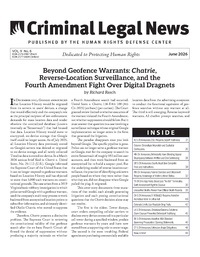
by Richard Resch
In December 2023, Google announced that Location History would be migrated from its servers to users’ devices, a change that would effectively end the company’s role as the principal recipient of law-enforcement demands for mass location data and render obsolete the centralized database (known internally …
by David Kim
The Supreme Court of New Jersey unanimously held that historical cell site location information (“CSLI”) may not be presented to a jury through a lay witness. Instead, because CSLI carries probative force only when the jury understands how cell towers and cellphones interact, the Court …
by David M. Reutter
The United States Court of Appeals for the First Circuit held that a District Court commits reversible error when, in assessing a defendant’s eligibility for a mitigating-role adjustment under U.S.S.G. § 3B1.2, it restricts the universe of participants solely to the defendant’s own conduct …
by David Kim
A man is arrested late on a Friday night and held overnight. By morning, detectives are ready to talk. He slept a few hours in the holding cell. He has not been awake for 24 straight hours. No one denied him food or water. At …
by Douglas Ankney
The United States Court of Appeals for the Fourth Circuit vacated a defendant’s sentence and remanded for resentencing after concluding that the warrantless-search condition in the written judgment materially differed from what the U.S. District Court for the Eastern District of North Carolina orally announced …
by David Kim
The Supreme Court of Oregon, sitting en banc, held that Oregon Rule of Civil Procedure (“ORCP”) 59 B, which applies in criminal cases through ORS 136.330, requires a trial court, at the conclusion of trial and before the jury retires to deliberate, to orally state …
by Douglas Ankney
The United States Court of Appeals for the Sixth Circuit held that 18 U.S.C. § 2422(b), the federal coercion and enticement statute, requires a defendant to know that the victim is a minor. Applying this interpretation, the Court ruled that Florida lewd and lascivious battery, …
by David Kim
The Supreme Court of Colorado, sitting en banc, unanimously held that the prosecution’s second pretrial appeal, challenging a county court evidentiary ruling under CRE 401, 402, and 403, did not qualify as an “interlocutory appeal” under Colorado’s speedy trial statute because the prosecution’s assertion that …
by David Kim
The Court of Criminal Appeals of Texas reversed a suppression order and held that a defendant’s Sixth Amendment right to counsel terminates when charges are dismissed, rejecting the argument that the right persists indefinitely after a grand jury no-bill. The Court clarified that its prior …
by David Kim
The United States Court of Appeals for the Fourth Circuit reversed the denial of a defendant’s motion to suppress and vacated his guilty plea, holding that a U.S. Forest Service officer exceeded the permissible scope of a traffic stop by abandoning the stop’s stated purpose …
by Jo Ellen Nott
In a study led by Andrew Stokes of Boston University, researchers developed algorithms trained on hospital-verified data to audit out-of-hospital deaths during the COVID-19 pandemic. The results, published in Science Advances, point to “critical gaps in the U.S. death investigation system.”
The study’s …
by Jo Ellen Nott
A study published in the Journal of Applied Psychology quantified a systemic threat to public safety, viz., the “wandering police officer.” By analyzing 6,075 officers across 150 agencies for up to five years, researchers whose work was published by the American Psychological Association found …
by David Kim
The Supreme Court of California held that Penal Code § 189, subdivision (e)(2) requires a nonkiller participant in a qualifying felony to have aided or abetted the actual killer in the lethal act itself. Proof of aiding the underlying felony alone is insufficient to sustain …
by Jo Ellen Nott
With the signing of HB26-1020 on March 26, 2026, Colorado became the first state to enact a targeted law limiting the harms caused by colorimetric field drug tests. The reform is narrow but important. Although it does not ban police from using these kits, …
by David Kim
The Texas Court of Criminal Appeals held that the “presence or view” language found in multiple warrantless-arrest statutes requires an officer to actually perceive the offense through his or her senses, and an officer who arrives at a crash scene 40 minutes after the fact …
by Jo Ellen Nott
Traffic enforcement has moved far beyond speed traps and roadside officer observations into a realm of constant, algorithmic monitoring. As companies like Hayden AI and Acusensus market and deploy smart camera systems, the legal landscape is shifting from traditional policing toward automated roadway surveillance …
by David Kim
The Supreme Court of Louisiana held that when a defendant on collateral review alleges defense counsel prevented him from testifying, the claim must be evaluated under the two-prong standard set forth in Strickland v. Washington, 466 U.S. 668 (1984), requiring proof of deficient performance and …
by Douglas Ankney
The Supreme Court of Delaware, sitting en banc, reversed Yony Morales-Garcia’s convictions and remanded for a new trial, holding that the State committed plain error when it repeatedly referred to his brother and co-defendant’s guilty plea during trial. The Court concluded that the prosecutor’s opening-statement …
by David Kim
The Supreme Court of Connecticut unanimously held that a prosecutor’s Brady obligations may extend to impeachment information about a State witness known within the same State’s Attorney’s Office, even when it arose in an unrelated case. The Court rejected the Appellate Court’s conclusion that the …
Loaded on
May 1, 2026
published in Criminal Legal News
June, 2026, page 49
Arizona: Pima County Sheriff’s Department (PCSD) Dep. Travis Reynolds, 22, was arrested and fired on March 27, 2026, for sexual misconduct during a custodial transport, KPNX in Mesa reported. Prosecutors charged Reynolds with kidnapping after he held a handcuffed arrestee in his cruiser for two hours outside the …